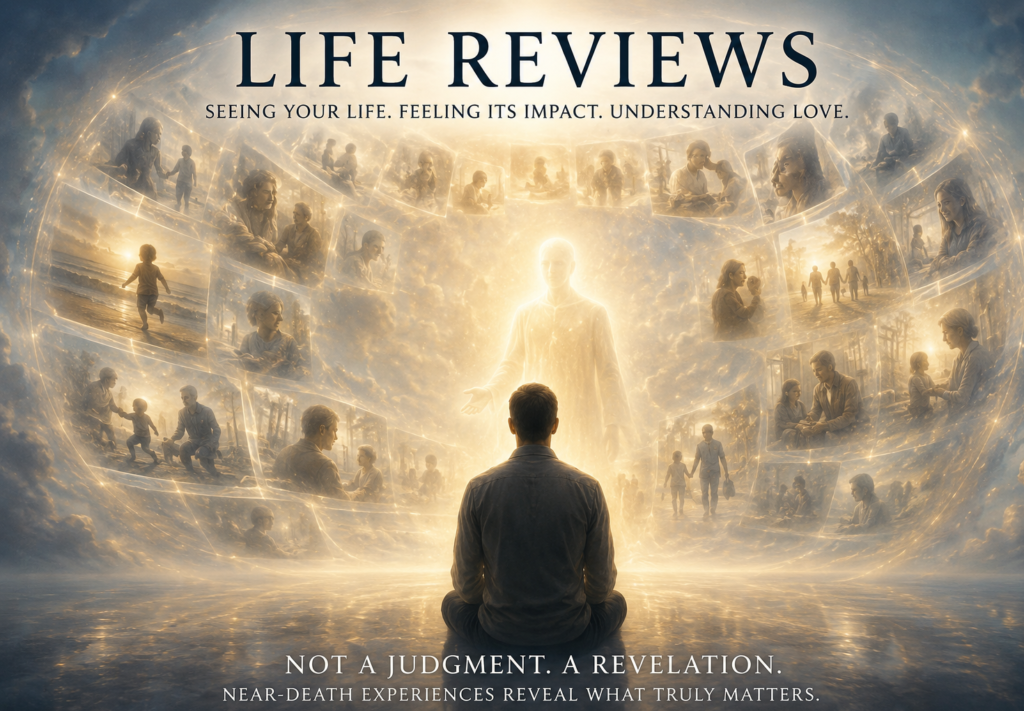
Imagine watching your entire life again. Not as a memory, but as something you vividly relive. Every conversation. Every choice. Every moment you wish you could take back and every moment of quiet kindness you had already forgotten. And this time, you feel it from the other person’s side too. This is what thousands of people describe during an NDE life review and it is one of the most extraordinary elements of the near-death experience.
That is the life review. One of the most consistent and most misunderstood elements of the near-death experience. It is not a courtroom. It is not a tally of sins. It is something far more tender than that and it may be one of the clearest glimpses we have of how God actually sees us.
What Happens During a Life Review?
Experiencers describe a panoramic, often instantaneous replay of their life. Sometimes from birth to the moment of near-death, sometimes focused on a handful of pivotal moments. What sets it apart from ordinary memory is the texture of it: every scene is felt, not just seen.
People don’t just recall raising their voice at a sibling. They feel the sting of the words land, from inside the sibling’s chest. They don’t just remember a small kindness, a held door, a word of encouragement. They feel the quiet lift it gave someone they’d long forgotten. Cause and effect, collapsed into a single felt moment.
That is not a memory. That is a reckoning. And it happens in the presence of a love that does not flinch.
This is usually experienced in the presence of the Being of Light. Not as an observer grading a performance, but as a presence walking through the memories alongside the experiencer. Many describe the strange, almost contradictory truth of it: total honesty, paired with total love.

Is the Life Review a Judgment?
This is the question almost everyone asks first, and the honest answer is: not in the way we tend to picture judgment.
Experiencers consistently describe the absence of condemnation. The Being of Light does not deliver a verdict. There is no scorekeeping, no sentence handed down. Instead, people describe a kind of mutual seeing, as if the point was never to punish, but to understand. To finally see a life the way love sees it.
“For God did not send his Son into the world to condemn the world, but to save the world through him.” John 3:17
That verse is the hinge this whole conversation turns on. A God who sent His Son specifically to avoid condemning the world is unlikely to ambush His children with condemnation the moment they die. What experiencers describe instead is something closer to grace doing its deepest work. An unveiling, not a sentencing.
Why the Life Review Points to Grace, Not Fear

Three things stand out across thousands of documented life reviews, and each one echoes something Scripture already told us.
It is relational, not transactional. Love given. Love withheld. The ripple each choice sent outward. That is the entire report card. Not your achievements. Not your income. Not your title or your reputation or how many people showed up to your events. Just love. Which is exactly what Jesus said when they asked Him what mattered most. Love God. Love your neighbor. Matthew 22:37-40. He was not being poetic. He was describing the life review two thousand years before anyone had language for it.
It is honest without being cruel. Nothing is hidden. Nothing is softened. Every moment is there, the beautiful ones and the ones you would give anything to take back. And yet. Experiencers come back saying they felt more loved during the review than they had ever felt in their entire lives. That is the math of grace that Paul described. While we were still sinners, Christ died for us (Romans 5:8). A love that saw everything. And came anyway. Not after you cleaned yourself up. Not after you got it together. While you were still a mess. That love was already there.
It changes people permanently. Nobody comes back from a life review and returns to the same priorities. Nobody. They come back choosing love over achievement. Presence over performance. Forgiveness over being right. That is not the fruit of fear. Fear produces shame and hiding and self-protection. What the life review produces is transformation. Which is exactly what Jesus said would identify a genuine encounter. You will know them by their fruit (Matthew 7:16). The fruit of the life review is unmistakable. And it looks nothing like fear.
“Nobody comes back from a life review and returns to the same priorities. Nobody.”
The Wave & RippleI think about that a lot. Because it means the life review is not something to dread. It is something to prepare for, by living now the way you will wish, on that day, that you had always lived. Every kindness matters. Every moment of love given or withheld is being written somewhere. And one day you will feel every word of it.
That is not a threat. That is an invitation.
The Ripple Inside the Review
At The Wave & Ripple: the life review is, in a sense, the ripple made visible.
Every kindness someone has ever shown moved outward further than they knew and the life review lets them finally see how far. Every small cruelty did too. Nothing was ever isolated. Nothing was ever just between two people. The life review reveals what was true the whole time: that we are not separate from one another, and that love, once given, keeps moving long after we’ve forgotten we gave it.
I’ll admit this idea has wormed its way into my everyday life, in a half-joking way that’s actually kept me honest. Whenever I see someone being unkind, a stranger on the street, a name in the news, a celebrity caught behaving badly, I find myself muttering, “That’s going in your life review.” It started as a joke. But it’s become something more like a built-in alarm. It keeps me aware of my own actions, too, because if it’s true for them, it’s true for me. Every interaction is being recorded somewhere, and one day I’ll feel it from the other side.
Here is what that looks like in real life.
I was in a grocery store. Standing behind a woman who didn’t have enough money to cover her groceries. I watched her face as the total came up. That particular kind of embarrassment, quiet, private, devastating, as she started choosing items to put back. Deciding which things she could live without. Right there at the register. In front of everyone.
I quietly handed my card to the cashier so she could cover the difference. Nothing said out loud, nothing for anyone around us to notice. The woman was grateful. But what stayed with me was the cashier. As she rang up my groceries, she started weeping. I asked if she was okay, and she told me she had lost her faith in people and that what she’d just watched had restored it.
I never saw that woman again. I have no idea what her life review will hold. But I think about that cashier, someone I never set out to reach at all, and I understand a little better what it means to say no kindness is ever isolated.
That is not a frightening thought. It’s an invitation to live now the way you’ll wish, one day, that you had lived all along.

Real Accounts of the Life Review
If you want to read the life review in someone’s own words rather than take it secondhand, these are three of the most well-documented accounts in the field, each a little different from the others.
Dannion Brinkley. Struck by lightning in 1975, Brinkley described a panoramic life review unlike ordinary memory. He relived his choices from the perspective of everyone he had ever affected, feeling both the harm and the good he had caused from the inside. His account is detailed in his book Saved by the Light.
Gabe Poirot. In 2021 Gabe Poirot had a catastrophic accident that left him clinically dead and then in a coma for eighteen days. Eighteen. Days. When he came back he described two things that matter deeply for this conversation. A face-to-face encounter with Jesus and a life review he describes as marked by mercy rather than condemnation. That phrase. Marked by mercy. That is the life review in three words. His book is called 18 Days in Heaven.
Anita Moorjani. Anita Moorjani did not go to the hospital hoping to get better. She went to die. Stage 4 lymphoma. Organs shutting down. Hours left. During her NDE she describes seeing her life as one interconnected whole, every relationship, every choice, every ripple she had sent outward felt in real time from every direction at once. She came back. The cancer disappeared. Completely. Her medical team documented it and could not explain it. What they could not measure was the encounter with love that preceded it. Her book is Dying to Be Me.
These accounts differ in tone and detail but the core of the life review holds steady across all three: total honesty, no condemnation, and a love that remains constant no matter what is being reviewed.
Where to Go to Read More
Saved by the Light by Dannion Brinkley A detailed firsthand account of one of the most-cited panoramic life reviews on record.
18 Days in Heaven by Gabe Poirot A recent, Christ-centered account of a life review marked by mercy, endorsed by John Burke himself.
Dying to Be Me by Anita Moorjani A widely-discussed account of a felt life review and a medically remarkable recovery that followed it.
Imagine Heaven by John Burke Cross-references over a thousand NDE accounts, including many life reviews, against Scripture.
IANDS.org The International Association for Near-Death Studies, with a free archive of firsthand accounts submitted directly by experiencers.
Frequently Asked Questions: The NDE Life Review
What is a life review in a near-death experience?
A life review is a panoramic, deeply felt replay of a person’s life that many people report during a near-death experience. Experiencers don’t just remember their choices. They feel the emotional impact those choices had on others, often in the presence of a loving, non-judgmental Being of Light.
Does the NDE life review match what the Bible says about judgment?
Surprisingly close. Scripture describes a God whose aim is salvation rather than condemnation (John 3:17), and the life review is consistently described the same way, as an honest unveiling meant to transform, not a punishment meant to condemn.
Is the life review the same for everyone?
The core elements, felt emotion, total honesty, and a loving presence, are consistent across cultures and belief systems. The specific content is unique to each person, shaped by the relationships and choices of their own life.
Why don’t people feel condemned during their life review?
Experiencers consistently say the Being of Light’s response to even their worst moments was love, not anger. Many describe this as the moment they finally understood unconditional love. Not as a concept, but as something they felt directed at them personally, in full view of everything they’d ever done.
Want to go deeper into what people encounter at the edge of eternity?
Start here: What Is a Near-Death Experience? A Beginner’s Guide • What Do People See During an NDE?