5 Most Common Elements of a Near-Death Experience
When I first stumbled onto the topic of near-death experiences I was skeptical. Logical. Not the kind of person who takes things at face value. So the first thing I did was look for patterns. If these experiences were real, I reasoned, there should be consistency. Different people, different countries, different belief systems, and the same story. That is either the most compelling evidence in the world or the most elaborate coincidence in human history.
Spoiler alert: it is not a coincidence.
After three years of research, reading hundreds of accounts and diving into the science behind them, the consistency is the thing that gets me every time. People who have never met, who have never read each other’s stories, who grew up in completely different parts of the world with completely different ideas about God, they come back describing the same five things. Over and over and over again.
Here they are. The 5 most common elements of a near-death experience, and what each one points to.
1. Leaving the Body

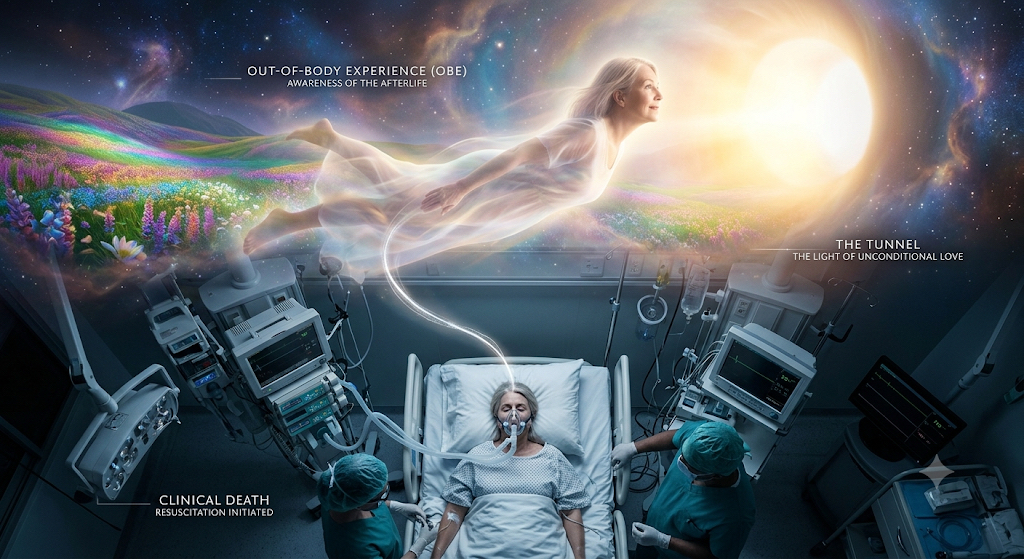
Almost every NDE begins the same way. The person separates from their physical body and watches everything from above. They see paramedics working on them. They overhear conversations in the hallway. They describe details of their own resuscitation with an accuracy that medical staff later confirm.
This is called an out-of-body experience, and it is the element that gives scientists the most trouble. A brain generating a hallucination during oxygen deprivation cannot accurately perceive what is happening in the next room. And yet, in documented case after case, that is exactly what happens. Vincent Tolman watched paramedics zip his own body into a body bag. Jim Woodford observed his own resuscitation from above the operating table. The details they came back with were verified.
What does it mean? That there is a part of us that is not the body. That consciousness is not contained by the skull. That what Paul wrote two thousand years ago turns out to be something people keep experiencing firsthand.
“For we are confident, I say, and willing rather to be absent from the body and to be present with the Lord.” 2 Corinthians 5:8
Want to go deeper on this one? What Do People See During an NDE?
2. A Tunnel or Darkness, Then a Light
After leaving the body, many experiencers describe moving through a darkness toward a light. Not darkness in the frightening sense, more like a deep, peaceful stillness. A velvet quiet. And then the light appears.

But here is the thing that gets me every time. The light is not just a light. It is warm. It is alive. It pulls you toward it not with force but with love. And many experiencers, including people who had never believed in Jesus, never attended a church, never opened a Bible, return identifying that light as Him. Not because they were told to. Because they recognized Him.
How do you recognize someone you have never met? That is the question I keep sitting with.
“I am the light of the world. Whoever follows me will never walk in darkness, but will have the light of life.” John 8:12
3. An Overwhelming Sense of Peace and Love
Every single account. The moment people leave the body, the fear goes with it. Pain vanishes. Anxiety dissolves. What replaces it is a peace so complete that most experiencers say it is the single hardest thing to describe when they come back. Not the absence of fear. The presence of something so much larger.
And then the love. The Being of Light, whether they call it God, Jesus, or simply the light, radiates a love that knows them completely. Every secret. Every shame. Every thing they have ever hidden. Fully seen. And the response is not judgment. It is love. Unconditional, all-knowing, nothing-you-can-do-to-earn-or-lose-it love.
People come back from this encounter changed at a cellular level. You cannot feel that and go back to the same life. You just can’t.
“And the peace of God, which transcends all understanding, will guard your hearts and your minds in Christ Jesus.” Philippians 4:7
4. The Life Review
This is the one that I personally cannot stop thinking about. And if you have spent any time on this site you already know why.
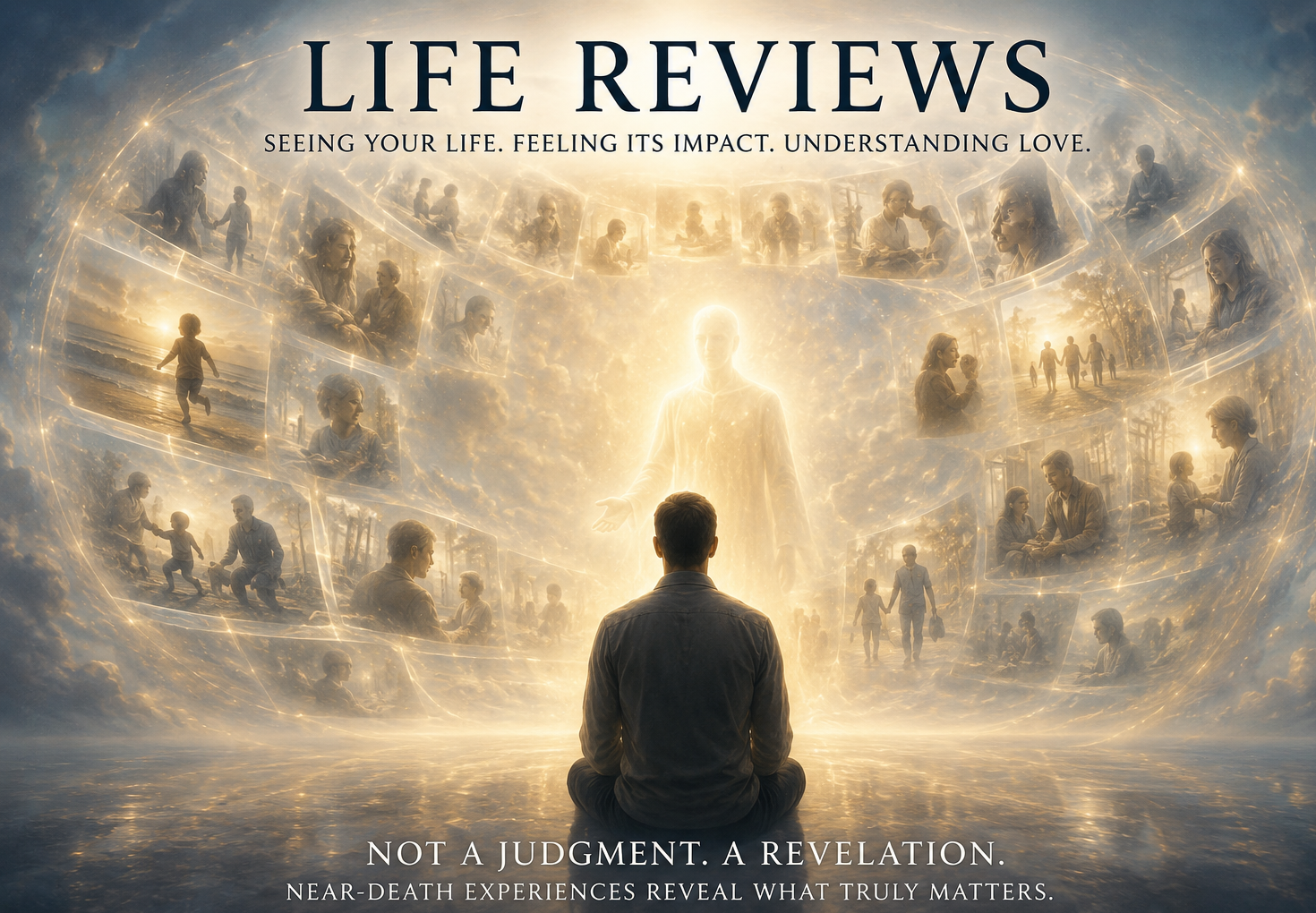
The life review is a panoramic, fully felt replay of the experiencer’s life. Not just seen, felt. From both sides. Every kindness lands the way it landed for the person who received it. Every careless word hits the way it hit. Every moment of love ripples outward further than you ever knew, and you feel all of it at once.
For many people the life review happens immediately, before the light, before the landscape, before anything else. As if the very first thing on the agenda on the other side is simply: let’s look at who you were. And then, consistently, across every account, the response from the Being of Light is not judgment. It is love.
Well. That’s going in your life review. I say that all the time now. And I mean it.
“Now I know in part; then I will know fully, even as I am fully known.” 1 Corinthians 13:12
This one deserves its own post. And it has one. What Is an NDE Life Review?
5. A Boundary and a Return

Almost every experiencer reaches a point they cannot cross. A border. A threshold. A place where something or someone tells them: not yet. It is not your time. You have to go back.
What is crazy is that almost none of them want to come back. The people who come back from near-death experiences almost universally describe not wanting to return. What they found on the other side made this world feel thin and grey by comparison. The love was too real. The peace was too complete. The sense of home was too overwhelming.
And yet they come back. Some are told to. Some choose to, for someone they love. Some are simply sent. And every single one of them returns carrying something, a knowing, a love, a changed life, that moves outward into the world like a ripple that never stops.
Jim Woodford did not want to come back. Jesus told him it was not his time and gave him an assignment: go back and tell your brothers and sisters what you have seen. He has been doing exactly that ever since. That is not a coincidence either.
“For to me, to live is Christ and to die is gain.” Philippians 1:21
So Why Does the Consistency Matter?
These five elements show up in accounts from people who have never heard of each other. From children who had no cultural framework for what an NDE should look like. From atheists who had no expectation of any afterlife at all. From people in India and Brazil and Canada and the United States and everywhere in between.
Same five things. Every time.
At some point consistency stops being a coincidence and starts being evidence. And the evidence keeps pointing in one direction. Toward a love that was there before we knew to look for it. Toward a God who turns out to be exactly who Jesus said He was. And toward a life that is far more than what we can touch or see or measure.
That is the quiet truth this site exists to explore. And if you are just starting to dig into it, welcome. You are in good company. Start with our beginner’s guide and go from there. I promise you, the further you go, the more compelling it gets.
“Ask and it will be given to you; seek and you will find; knock and the door will be opened to you.” Matthew 7:7
Start here: What Is a Near-Death Experience? A Beginner’s Guide
Curious what the science says? Is There Scientific Evidence for Near-Death Experiences?
Want to know what happens next? What Happens After a Near-Death Experience?
Frequently Asked Questions
What are the most common elements of a near-death experience?
The five most consistently documented elements are: leaving the body and observing it from above, moving through a darkness toward a brilliant light, encountering an overwhelming sense of peace and unconditional love, a life review in which the person relives their choices from both sides, and reaching a boundary or threshold before returning to life. These elements appear across thousands of accounts from people of every culture, age, and belief system.
Do all near-death experiences include all five elements?
Not always. Some NDEs include all five, some include only a few. The depth and sequence can vary from person to person. What is remarkable is how consistently these elements appear across thousands of accounts worldwide, regardless of the person’s background or belief system.
Why do so many NDEs describe the same things?
That is the question researchers have been trying to answer for fifty years. Neurobiological explanations account for some elements but not all, particularly the veridical cases where people accurately describe events happening around their unconscious bodies, and the consistent cross-cultural content that appears even in people with no prior religious belief or expectation of what death would look like. The most honest answer is that science does not yet have a complete explanation. Is There Scientific Evidence for Near-Death Experiences?
Is the life review the same as judgment?
Not in the way most people picture judgment. The life review is consistently described as a compassionate, honest unveiling, not a courtroom verdict. The Being of Light walks through the memories alongside the experiencer, and the overwhelming response is love rather than condemnation. What Is an NDE Life Review?
What happens after a near-death experience?
The aftereffects are some of the most well-documented findings in NDE research. The fear of death disappears. Love becomes the center of everything. Material things lose their importance almost overnight. Many return with a deep sense of purpose and a faith that was either born or completely transformed by what they encountered. What Happens After a Near-Death Experience?